

by Elizabeth Lhuede
 A post in our 2026 series featuring works published in 1946 or by authors who died in 1946.
~
I was hoping to post this month on the women’s contribution to the Jindyworobaks anthology as a companion piece to my June post on women in the Angry Penguins in the 1940s, but life has got in the way. Instead, I’ll refer briefly to one poet, Mary Fullerton, whose poem, The Real Waltzing Matilda, was published in the 1946 Jindyworobaks anthology and who died that same year.
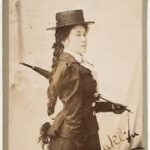
Mary Eliza Fullerton, poet, novelist and nonfiction writer, was born in 1868 in Glenmaggie, on the Gippsland goldfields in Victoria. She was one of a crew of seven children who grew up in a bark hut and home-educated. Her upbringing was the subject of her book, The Bark House Days, published in 1921. In 1922, she moved to England to live with her friend, Mabel Singleton, and died in February 1946 in Maresfield, East Sussex, England. Sylvia Martin writes about Fullerton and Singleton in her 2021 book, Passionate Friends: Mary Fullerton, Mabel Singleton and Miles Franklin, tracing these women’s friendships. Martin records how Fullerton’s poetry was saved for posterity in the early 1940s by the intervention of Miles Franklin after a twenty-year correspondence between the two writers. After Fullerton’s death, Franklin revealed in The Bulletin’s Red Page that she had been the author of a collection, Moles Do So Little With Their Privacy (1942), published under the pseudonym, “E.”. Franklin discussed Fullerton’s shyness and sense of disadvantage over not having had a traditional education, something the two writers had in common. Fullerton has entries in both the Australian Dictionary of Biography and in the AustLit database. The literary reception of her work at the time of her death and since has been mixed.
The following obituary appeared in The Tribune on 24 May 1946 and gives us a glimpse of Fullerton’s life and a flavour of her poems, as well as how her efforts were received in her day:
MARY FULLERTON—THE MYSTERIOUS “E”: SHE WROTE FOR LABOR
Mary Fullerton is a name known to few save students of Australian literature, although it might well be remembered by readers of Ross’s Monthly or the Victorian Socialist, militant-Victorian papers of the 1914-18 period.
MARY FULLERTON was born in Gippsland, and lived for some time in Melbourne; in the early 1920’s she went to England, where she remained until her death on February 23, 1946.
In all her work, from those poems published in early radical papers, to those in her later volumes published under the nom-de-plume “E.” she expressed her sympathy with the struggles of the Labor Movement, and, by her writing, assisted the anti-conscription campaign of 1917.
Later in her life, when she had settled in England, she continued writing of the everyday life of the people, and her message to poets of today is contained in these lines:—
Life, and struggle and moil,
Day and day in the rough,
Poets knowing not these
Have not knowledge enough.As her friend Miles Franklin has said, Mary Fullerton’s writing, both prose and poetry, was not widely appreciated here [in Australia] during her life, although grudging tributes came when she published an anonymous volume in 1940.
An interesting example of her work is the following poem written to “Mick,” a working woman’s baby born during a strike struggle:—
You poor little Mick,
So here you arrive;
Born in the strike.
You seem scarce alive!
Your poor little face
So pinched and forlorn,
Creased with the puzzle
Of why you were born.
Your mother has drunk
From a fountain of fears,
That’s why your milk
Is tasting of tears. . . . .
Ah, no! little Mick,
Her courage is fine;
Her milk has the taste of
Rebellion’s good wine.
Smooth your wee brow
And slake your lips’ drouth,
Then turn in your sleep
With that tang in your mouth!
The omen is good —
They are born in times stern
Who are marked by the gods
To teach and to learn!
Your mouth is a word,
Your tongue is a pen;
Wee Mick has a message
To-morrow for men.As one of Australia’s army of sometimes forgotten poets of the people, Mary Fullerton’s work is being re-discovered and will take its rightful place alongside the work of those better known fighters for democracy. Henry Lawson, Victor Daley and Bernard O’Dowd.
~
References
Franklin, M. “‘E.’: The Full Story”, The Bulletin, Vol 67, no 3457: The Red Page: https://nla.gov.au/nla.obj-542533083/view?partId=nla.obj-542628310#page/n1/mode/1up
Image of Mary Fullerton from State Library of Victoria collection, https://handle.slv.vic.gov.au/10381/402083.
Mary Fullerton, AustLit entry: https://www.austlit.edu.au/austlit/page/A1331
Mary Fullerton, Australian Dictionary of Biography entry: https://www.austlit.edu.au/austlit/page/A1331
Obituary: “Mary Fullerton – The mysterious ‘E.'”, The Tribune, 24 May 1946: https://trove.nla.gov.au/newspaper/article/206683762
 Elizabeth Lhuede has a PhD in Australian Poetry from Macquarie University. In 2012, she instigated the Australian Women Writers Challenge as a contribution to overcoming gender bias in the reviewing of works by Australian women. More recently she has focused on bringing to light the life and works of forgotten Australian women writers.
Nearly all I know about Fullerton comes from Passionate Friends which I heartily recommend for its insights into Miles Franklin and for an inside view of the suffragist movement under Vida Goldstein in Victoria.
‘E’, Fullerton’s middle initial, was a little joke between the two MFs.
Thanks for dropping by, Bill. The only one of Sylvia Martin’s literary biographies I’ve read is Ink in her veins: the troubled life of Aileen Palmer, which was extraordinary. When I have time, I’ll get onto Passionate Friends. It sounds very interesting.